
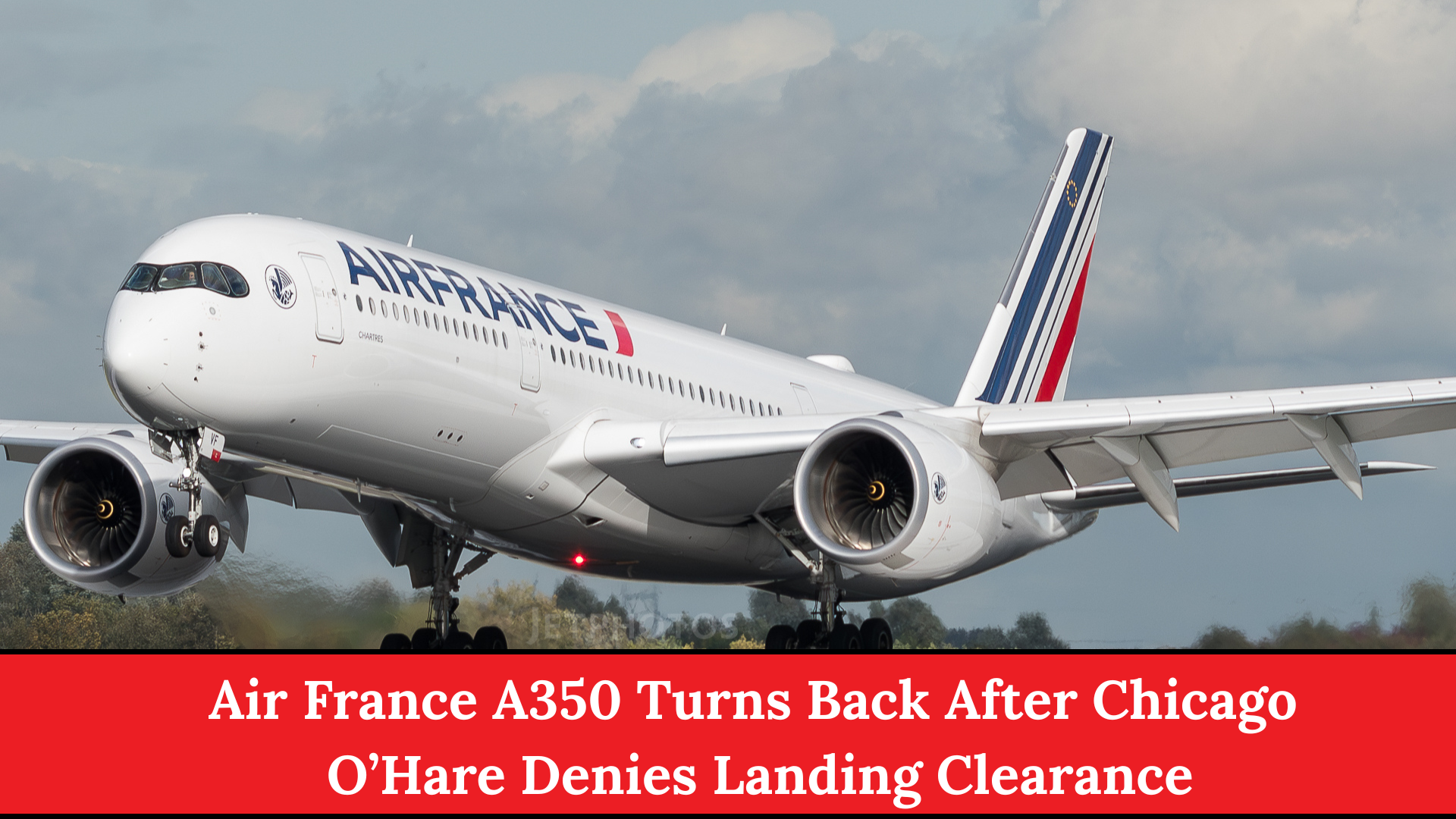

Air France A350 Turns Back After Chicago O’Hare Denies Landing Clearance. A routine transatlantic journey turned into a rare mid-air reversal when an Air France Airbus A350, bound for Chicago, was forced to return to Paris after spending nearly seven hours in the sky.
The incident involved Air France flight AF136, which departed Paris with hundreds of passengers expecting to land at Chicago O’Hare International Airport. Instead, the aircraft never reached North America and made an unexpected return to France due to operational clearance issues.
What Really Happened Mid-Atlantic
Flight AF136 took off from Paris–Charles de Gaulle Airport at 12:49 PM local time on Saturday, June 28, 2025. The aircraft, an Airbus A350-900, climbed smoothly to cruising altitude and followed a standard transatlantic route via the UK.
For several hours, the flight progressed normally. However, while flying between Iceland and Greenland, the situation changed.
At around 16:30 CEST, pilots initiated a turnback maneuver over the Atlantic Ocean. At that point, the aircraft had already covered almost half the distance to Chicago.

Passengers were later informed that the aircraft was unable to receive landing clearance at Chicago O’Hare, forcing the crew to abandon the journey and return to Paris.
Air France Confirms Operational Reasons
While a passenger speaking to aviation outlet AIRLIVE confirmed that the issue involved landing authorization, Air France officially described the incident as an “operational decision.”
No safety concerns were reported, and weather conditions in Chicago were normal at the time.
The Airbus A350 landed safely back at Paris–Charles de Gaulle Airport on runway 27R, exactly 6 hours and 37 minutes after departure.

Passenger Care and Rebooking
Following the return, Air France activated its disruption management protocol.
Affected passengers were:
- Provided overnight hotel accommodation
- Assisted with meals and airport support
- Rebooked on a replacement flight
A substitute service, Flight AF4080, departed Paris for Chicago on Sunday, June 29 at 2:20 PM, allowing passengers to complete their journey with minimal additional delay.
Why Would Chicago O Hare Deny Landing Clearance?
Even at major hubs like Chicago O’Hare, landing permission is not automatic.

Clearance can be denied due to:
- Airport capacity restrictions
- Air traffic flow limitations
- Regulatory or operational constraints
- Aircraft scheduling or certification issues
In rare cases, airlines must decide whether to divert to another airport or return to origin. In this situation, returning to Paris was deemed the safest and most practical option.
Similar Case Shows This Is Not an Isolated Issue
Just weeks earlier, a similar operational oversight affected American Airlines Flight AA780, flying from Philadelphia to Naples.
That flight was diverted to Rome after the crew discovered mid-flight that the assigned Boeing 787-9 was not certified to land at Naples Airport — despite clear weather and no airport disruptions.
Aircraft Type Matters More Than Passengers Realize
Although aircraft variants may look similar, small differences can create big operational problems.
For example:
- The Boeing 787-9 is longer and heavier than the 787-8
- It requires different runway, braking, and gate specifications
- Not every airport approves every aircraft variant
Airports must certify each aircraft type individually. In both the Air France and American Airlines cases, compatibility and clearance issues surfaced only after departure, leading to costly diversions.
Operational Lessons for Airlines
These incidents highlight a growing challenge in long-haul aviation.

Airlines today operate:
- Complex international schedules
- Mixed aircraft fleets
- Airports with strict certification rules
A single missed clearance or aircraft mismatch can result in mid-air turnbacks, disrupted passengers, and major operational costs.
Conclusion
The return of Air France flight AF136 after nearly seven hours in the air shows that even modern aircraft and major global airports are not immune to operational surprises.
While safety was never at risk, the incident underscores the importance of pre-flight clearance checks, aircraft compatibility, and real-time coordination between airlines and destination airports